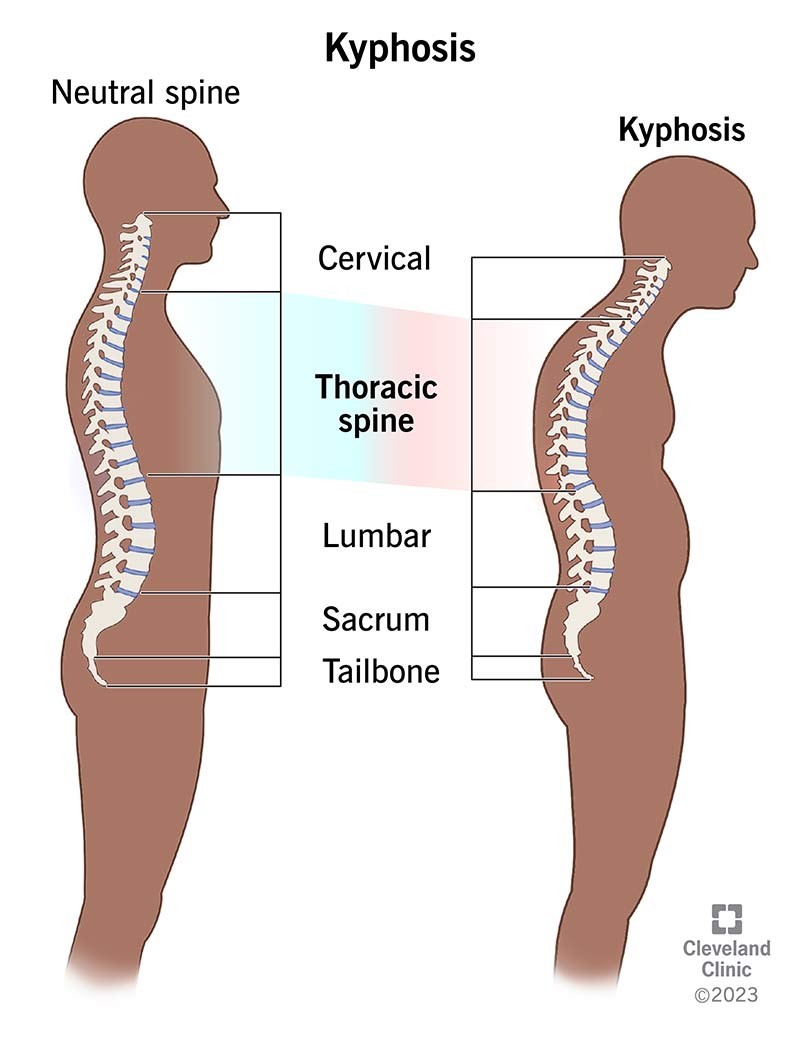
Kyphosis Kyphosis is an excessive forward curve of your spine. This condition can cause you to lean forward like you’re hunching over. It might cause back pain and stiff muscles. There are nonsurgical and surgical treatment options available.What is kyphosis?Kyphosis is a condition where your spine curves outward more than it should. This causes your upper back around the thoracic region (the part of your spine between your neck and ribs) to bend forward. The curvature can make it look like you’re hunched over or slouching. People sometimes call it “hunchback” or “roundback.”Your spine has natural curves. These curves support your posture and help you stand straight. But excessive curvature can affect your body and make standing difficult.Most of the time, kyphosis doesn’t cause health problems or need medical treatment. But it may make you feel self-conscious about how you look. In severe cases, kyphosis can cause pain or breathing issues. Severe kyphosis may require surgery.What are the types of kyphosis?There are several types of kyphosis. Some of the most common include:Postural kyphosis: This is the most common type of kyphosis. It usually happens during your teenage years. Slouching or poor posture stretches the ligaments and muscles holding your vertebrae (spinal bones) in place. Stretching pulls your vertebrae out of their normal position, causing a rounded shape in your spine. It affects more girls than boys. It doesn’t usually cause pain.Scheuermann’s kyphosis: This type happens when vertebrae have a different shape than expected. Instead of being rectangular, your vertebrae have a wedge shape. The wedge-shaped bones curve forward, making your spine look rounded. It affects boys more than girls. Scheuermann’s kyphosis can be painful, especially during activity or when standing or sitting for a long time. Changing your position or posture doesn’t change the curve, as your vertebrae aren’t flexible.Congenital kyphosis: Congenital means a condition present at birth. Congenital kyphosis occurs when your spine doesn’t properly develop or develop completely in the uterus. It can increase in severity as you grow. Surgery can correct the spine curvature during childhood to prevent it from worsening. It can happen in addition to other congenital growth defects like those that affect your heart and kidneys.Cervical kyphosis (military neck): This type occurs when your cervical spine, or the part of your spine at the bottom of your head to your upper back), curves toward your front instead of its natural curve to your back.Hyperkyphosis: Hyperkyphosis is a severe forward curvature of the spine. The curve measures more than 50 degrees. This type is common after age 40.How common is kyphosis?Less than 8% of school-aged children in the United States experience Scheuermann’s kyphosis.Hyperkyphosis (severe kyphosis) affects an estimated 20% to 40% of adults over age 60. On average, the forward angle of your upper spine increases about 3 degrees each decade (10 years).Symptoms and CausesWhat are the symptoms of kyphosis?The main symptoms of kyphosis include:Rounded shoulders.A curve or hump in your upper back.Tight hamstrings (muscles in the back of your thighs).Severe kyphosis may cause the following symptoms:Pain or stiffness in your back and shoulder blades.Numb, weak or tingling legs.
